
Customs invoices and commercial documents, parsed in batch.
Sender and recipient addresses, declaration date, every product line with HS code, country of origin, INCOTERMS, and currency, plus net and gross weights — extracted in one pass.
Live demo
See it on a real document.
Click a field on the right and we'll highlight where it came from on the left.
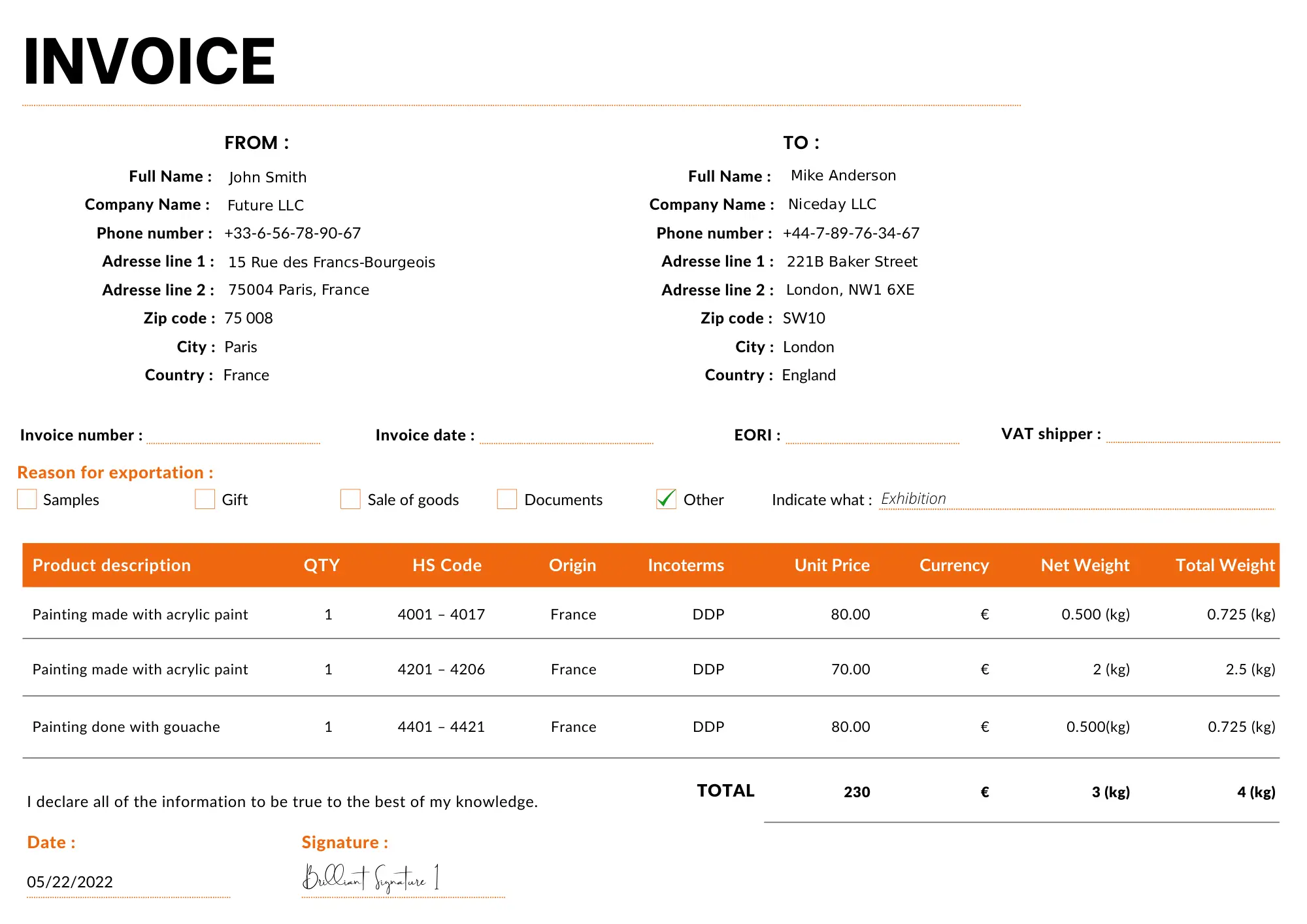
Extracted fields
To
From
Total
Products
| Origin | Hs code | Currency | Quantity | Incoterms | Net weight | Unit price | Total weight | Product description |
|---|---|---|---|---|---|---|---|---|
Sample data. Real engine output.
Overview
What is customs document data extraction?
Customs-document extraction turns commercial invoices, customs declarations, and similar trade-compliance paperwork into the structured data that customs brokers, freight forwarders, and trade-compliance teams feed into their entry-filing and screening tools. The use case is one of the most labor-intensive in international trade: HS codes need to be exact, weights need to reconcile to grams, and a typo on a party name can hold a shipment at the border.
On the sample document above, Ztract returns the full sender and recipient blocks — each with company name, contact person, phone number, full street address, city, country, and ZIP code; the declaration date; the total block with currency, net weight, gross weight, and declared price; and the products array with each line's HS code, country of origin, quantity, currency, and INCOTERMS. The shape maps cleanly into the fields that CBP, EU SAD, and most national customs forms require.
International trade documents vary by country, mode, and carrier. The engine doesn't depend on one template — Chinese exporters' commercial invoices, EU-bound declarations, and US CBP-bound paperwork all read into the same schema. HS codes are returned as printed (6–10 digits), not mapped to an outdated dictionary; INCOTERMS abbreviations are captured with their named place ('FOB Shanghai', 'CIF Hamburg'); and multilingual paperwork (Chinese shipper, English consignee, French port-of-loading) stays in its original script.
Hard parts
Where this gets tricky.
The reasons this doc type is harder than it looks — and how we handle them.
-
HS codes printed exactly as filed
Codes change with regulation — chapter-level changes happen yearly. The engine returns the full 6–10 digit code as printed on the document, not a mapping to an internal dictionary that may be out of date.
-
Multi-language paperwork
Chinese shipper, English consignee, French port-of-loading on one document. Each party block stays in its original script; addresses are kept structured (street, city, country, ZIP).
-
Sender and recipient as nested blocks
Both parties come back as complete address objects — company name, contact person, phone, street, city, country, ZIP — rather than collapsed into one ambiguous string.
-
INCOTERMS and origin per line
INCOTERMS (FOB / CIF / DDP / EXW / etc.) and country of origin are captured per product line, not just at the document level. Mixed-origin shipments stay correctly attributed.
Who uses it
Workflows this lands in.
-
Customs brokers
Pre-populate entry filings from the commercial invoice instead of typing each line into the customs portal — HS codes, INCOTERMS, and party details already structured.
-
Freight forwarders
Reconcile thousands of customs invoices per day against booking and tracking systems — sender and recipient addresses match against the carrier's manifest.
-
Trade compliance
Screen HS codes, countries of origin, and consignee names against sanctions and denied-party lists, with the source field cited for every match.
FAQ
Common questions.
Which customs documents does Ztract handle?
Are HS codes validated against a database?
Does it handle multi-line product tables across pages?
What about multilingual documents?
Can the output drive automated customs filings?
Related
Also useful for these documents.
-
Invoices & purchase orders
Line items, totals, tax IDs, currencies — across thousands of vendor layouts.
-
Contracts & NDAs
Parties, effective dates, renewal terms, governing law, signatures — out of dense legalese.
-
Bank & credit card statements
Opening and closing balances, every transaction, with running totals that reconcile.
Try it on your own document.
Start free with 30 pages. No credit card, no subscription, no setup.